How to create a Tiny Forest: Preparation
If you want to create a Tiny Forest, you will need to find the right partners and plan carefully. From selecting the site and assessing soil conditions to planting the right trees and shrubs, there are several factors to consider ensuring the forest fulfills its purpose over the long term. The most important steps are summarized here.
Planning the forest
Choosing the right location is a key milestone in the development of a Tiny Forest. The site should meet the following criteria:
A total area of at least 300 m² is recommended: 100–1.000 m² for the forest itself and additional 200m² for machinery access, material delivery, etc.
Must have:
- There must be no underground infrastructure: the soil must be excavatable to a depth of up to 1 meter.
- There must be no overhead infrastructure, as trees can grow over 20 meters high.
- The site must be accessible for heavy machinery.
- The Tiny Forest should not obstruct rights of way.
Should have:
- A nearby water connection that can be used is desirable.
- The area can have any shape but should not be narrower than 4 meters.
- The site should be an open area (no trees should be cut down to plant new ones).
- Public access to the site is desirable.
A site needs to be assessed in person. An site assessment protocol brings together the key information needed for the next stages of planning.
Engaging stakeholder and community partners
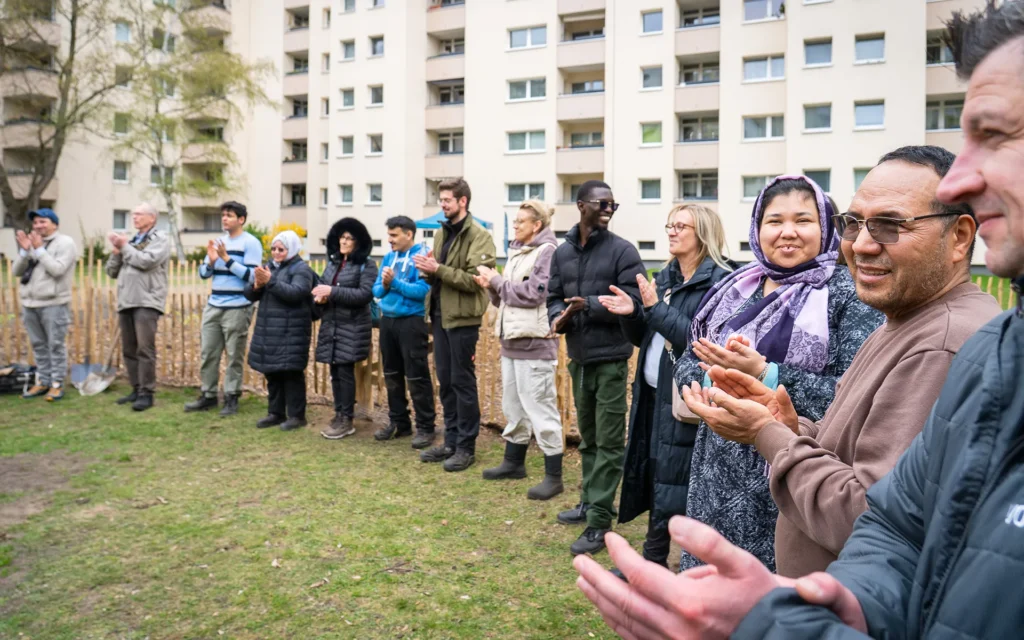
Begin involving stakeholders and the community as soon as the site is confirmed. Where possible, participants should come from the area immediately around the site. Involving neighbors, nearby schools, or local initiatives helps build a strong local connection and encourages people to stay involved after planting.
Key Steps
The key steps for anyone looking to start a Tiny Forest:
- familiarize yourself with local structures
- identify the right contacts
- engage in dialogue early on
Considering Stakeholder interests
Stakeholders may want seating areas, space for recreation or outdoor learning, or habitats for particular species, such as pollinators. Taking these views into account early helps avoid conflicts and builds support. Keep stakeholders informed in good time through flyers, emails, phone calls, or local information events. Early, open communication builds trust and encourages participation.
Permissions, regulations, and land ownership
Clarifying land ownership, permissions, and regulatory requirements is essential to ensure the legal security and long-term protection of the Tiny Forest.
Legal use rights: A Tiny Forest can only be established with the legal landowner’s agreement to provide the site. Ideally, the agreement should protect the site’s use as a Tiny Forest for at least 30 years, preferably longer. The written contract should clearly define:
- The parties to the contract
- The site’s exact location and size
- Each party’s rights and responsibilities
- Responsibilities for maintenance and access

Permits: Check early whether permits are needed for planting, soil work, changes in land use, or construction. Contacting local authorities early helps avoid delays. Requirements vary internationally, but the authorities responsible may include:
- Municipal planning or urban development departments
- Parks or green space authorities
- Environmental or nature conservation agencies
- Forestry authorities
- Construction or land-use authorities
Budget and resources
Project costs depend mainly on the country, the size of the project, and how much soil preparation is needed. Typical costs may include site preparation and soil improvement, plants and planting materials, machinery and transport, water supply, community events and planting activities, project management and coordination. The cost plan provides the basis for securing funding for the whole project. Include a sufficient financial buffer to cover unexpected costs.
Preparing the land
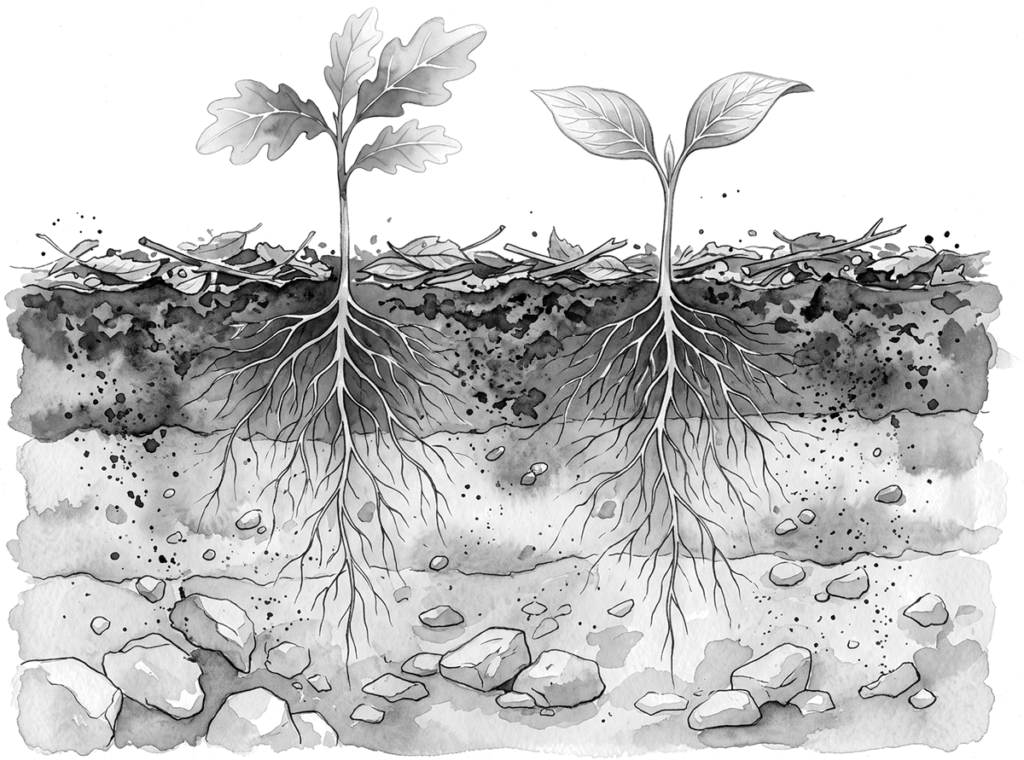
Many potential sites, especially in cities or on previously used land, have compacted, nutrient-poor, or disturbed soil that needs improvement before planting. Assessing and preparing the soil properly creates the conditions for the ecosystem to develop over the long term.
Soil Assessment
Knowing what type of soil is being worked with—sealed ground, poor soil, or healthy soil —helps determine which preparation steps will be needed later. This first first assessment is simple and can be done during the site assessment phase.
Soils differ mainly in the size of their particles. The three main types of particle are sand, silt, and clay. In sandy soils, water drains quickly, and nutrients are easily washed away. Silty soils hold more water and are generally fertile, but can become compacted easily. Clay soils hold water well but can become dense and hard. Loamy soils contain a balanced mixture of sand, silt, and clay and are usually ideal for plant growth.
Soils rich in humus are usually darker, softer, and better at holding water and nutrients. Soils with little humus are often lighter in colour, drier, and less fertile.
Soil improvement
Before planting, the goal is to create a loose, living, nutrient-rich soil that allows roots to grow quickly and supports long-term ecosystem development. In most Tiny Forest projects, soil preparation focuses on loosening compacted soil or increasing organic matter and soil life.
Designing the forest
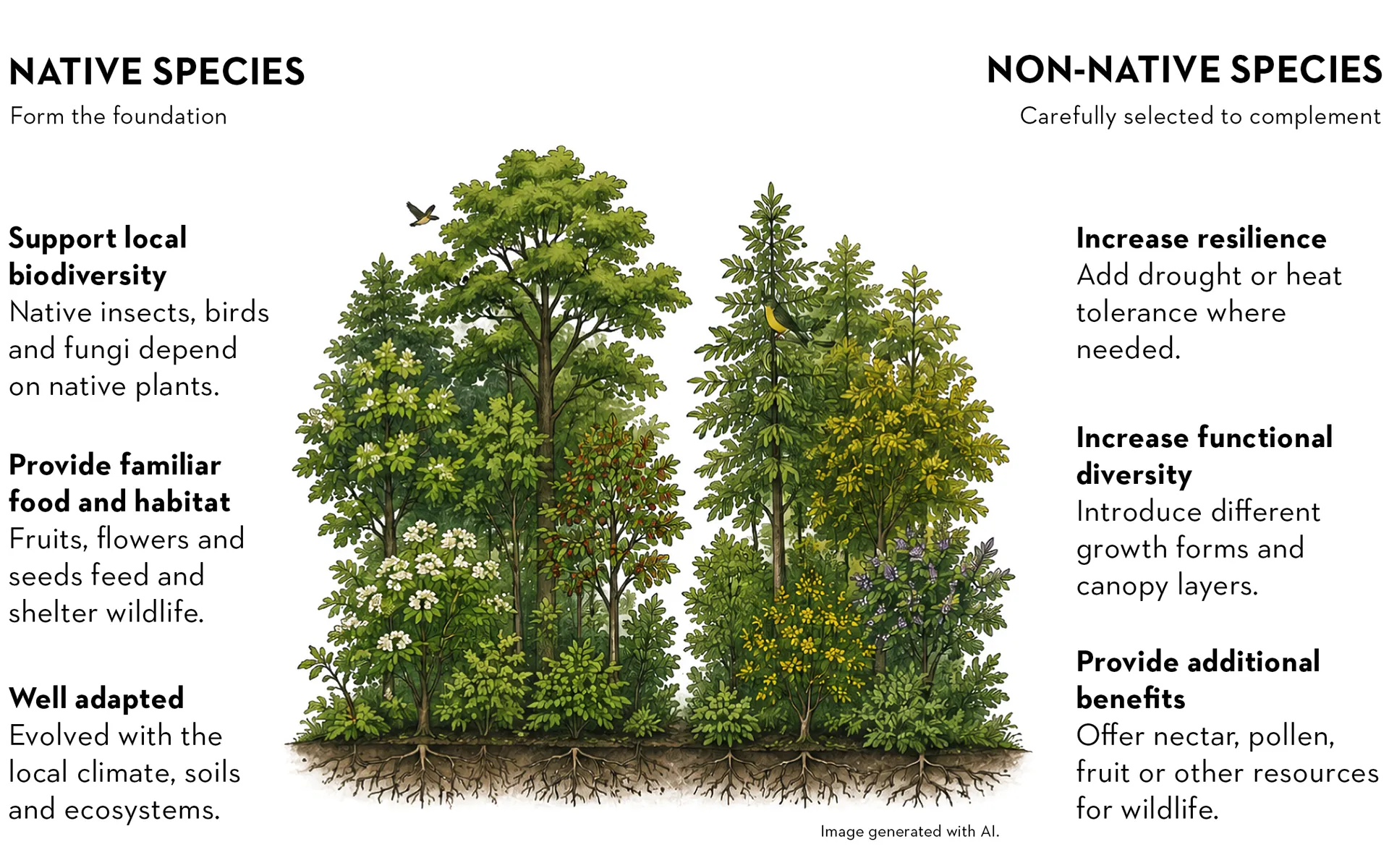
Native species are the foundation of every Tiny Forest because they provide the greatest value for local biodiversity. However, many Tiny Forests are planted in urban environments, where soils are disturbed, temperatures are higher than in surrounding areas, and air and light pollution is worse. Some native tree species already struggle under these conditions. As such, carefully selected (non-invasive) exotic species can help improve the resilience of the forest.
Aim for diversity
A diverse mixture of trees and shrubs is generally more resilient to pests, diseases, and extreme weather than a species-poor planting. Some species also establish quickly and provide early shelter, while others grow more slowly and eventually form the canopy. When selecting species, consider how the forest is expected to develop over the next 20, 50, or even 100 years.
Before you plant …
Before including a species, ask: Does the species contribute to local biodiversity? Is it well adapted to the site and future climate?
Make a planting list
A planting list defines the species that will make up the Tiny Forest. The site conditions like soil, sunlight or wind determine which species are likely to thrive and which are vulnerable. Online resources such as the BGCI Global Tree Portal can help with identifying tree species native to particular regions or countries. In order to promote biodiversity, it is a good idea to plant many different species of trees.
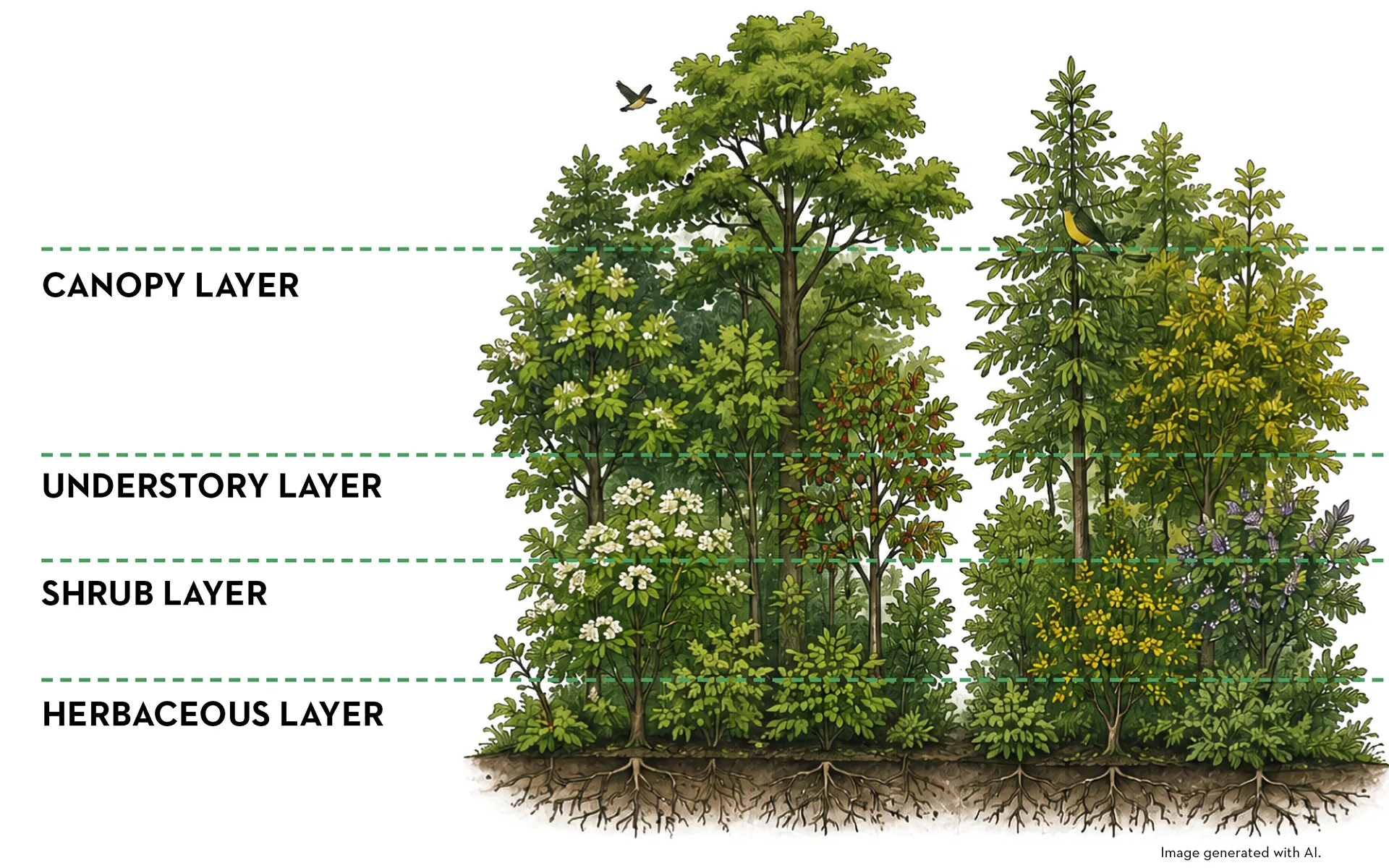
The planting list should include species that fulfil different roles within the forest. Some species establish quickly, others live longer. Some improve the soil, while others provide flowers, fruits, or nesting opportunities for wildlife. Common species are often planted in greater numbers than locally rare or specialist species, with species distributed across the canopy, sub-canopy, shrub, and ground layers. This layered structure allows the Tiny Forest to grow faster as trees use light, space, water, and nutrients more efficiently, reducing direct competition and encouraging species coexistence.
The Layers
Canopy layer: These are the tallest trees. Because they receive the most sunlight, they create a shaded, more humid environment for the layers below. The canopy also acts like an umbrella which protects the lower layers from storms and weather events.
Understory layer: The understory consists of trees shorter than the main canopy layer. Understory trees provide shelter for a wide range of animals. The understory is often dimly lit and without much wind due to the “roof” shield above.
Shrub layer: The shrub layer is characterized by woody species that grow relatively close to the forest floor. Shrubs protect the soil and promote biodiversity by providing nesting sites and often produce flowers and berries that support insects and birds.
Groundcover: The herbaceous layer is made up of plants such as grasses, ferns, wildflowers, and other low-growing vegetation. It retains moisture and provides habitat for many invertebrates.
Check availability
Check plant availability before finalizing the planting list. Find a nursery that can provide saplings around 80 to 90 centimeters tall, preferably with bare roots. For a Tiny Forest, order 3–5 trees per square meter.